Loading…
Contact Us
Get a free consultation!
Contact Us
Get a free consultation!
Train employees with AI simulations for sales, service, and leadership.


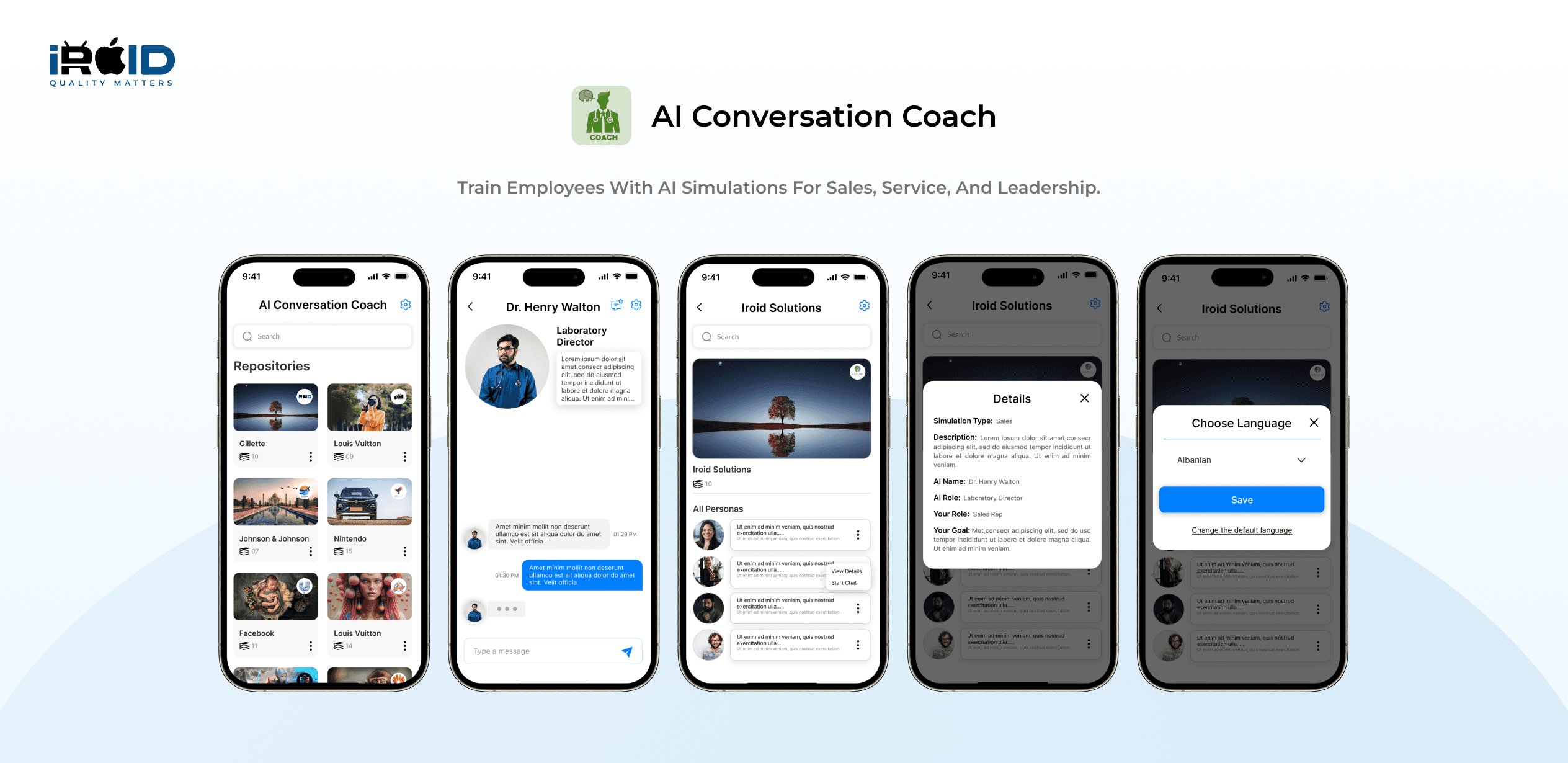
AI Conversation Coach is a training platform that uses conversational AI simulations to help employees practice real‑world scenarios in sales, customer service, and leadership.
iRoid Solutions delivered a complete ecosystem, Flutter mobile apps, a web app, backend APIs, and an admin panel, so organizations can design custom scenarios, assign them to learners, and track performance improvements over time.
Tools

Xcode

Android studio

VS code
Git
UI/UX

Figma
Cloud/Server

AWS

GoDaddy

Apache
Database
MySQL
Back-end

ExpressJs
Front-end

EJS

Html Bootstrap

HTML5
CSS3

JavaScript

jquery
Mobile

Flutter

Dart

Flutter
1 Member

Node.js
1 Member

QA
1 Member

UI/UX
1 Member

Project Manager
1 Member
Traditional role‑plays and classroom trainings often struggle to feel realistic, repeatable, and scalable. The AI Conversation Coach app was created to solve that by giving employees a safe space to practice high‑stakes conversations with AI personas that respond dynamically, just like real customers or team members.
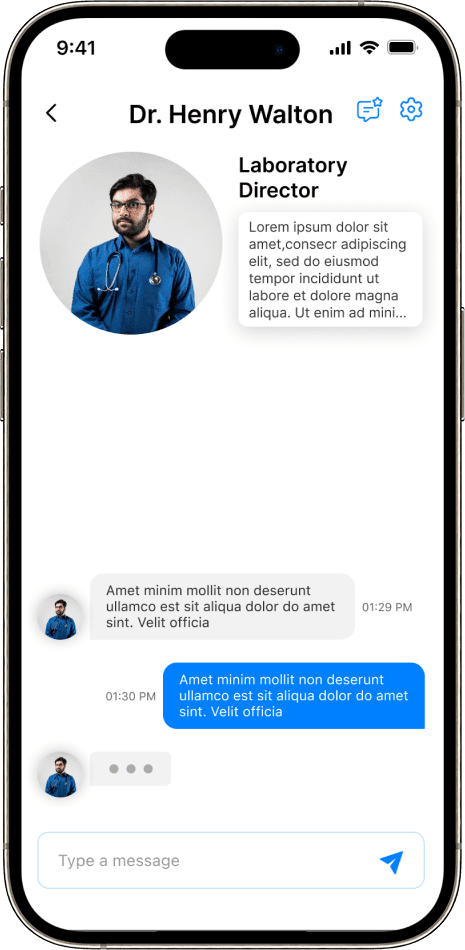
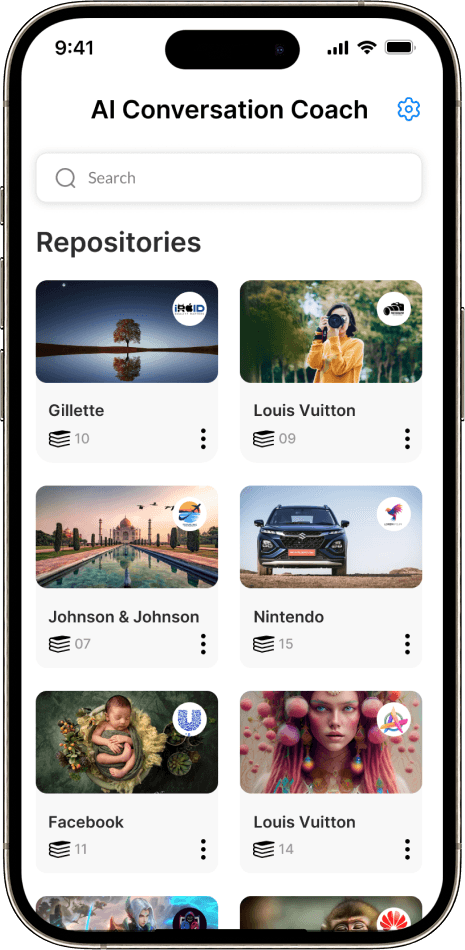
Users log in through the mobile app or web app, select a scenario (for example, handling objections on a sales call or managing a difficult performance conversation), and then engage in a simulated dialogue with an AI counterpart. The AI adjusts its responses based on what the learner says, creating a natural flow instead of scripted Q&A.
On the technology side, our team built Flutter apps for Android and iOS, backed by Node.js/Express APIs and a MySQL database, all deployed on AWS and integrated with a web front end built with HTML5, CSS3, Bootstrap, JavaScript, jQuery, and EJS. This stack supports real‑time chat, scenario configuration, role‑based access, reporting, and scalable AI usage through token‑based limits.
The admin panel allows training managers to design their own conversation scenarios, define AI personas, assign modules to user groups, and review performance data, turning the app into a flexible training platform rather than a fixed set of lessons.
The core business goal behind AI Conversation Coach was to help companies significantly improve frontline communication skills, close more deals, resolve issues faster, and lead teams more effectively, without increasing training overhead.
By offering customizable simulations and real‑time feedback, the platform aims to shorten ramp‑up time for new hires, provide ongoing practice for experienced staff, and give training teams a measurable way to see who is ready for live conversations and who needs more coaching.
From the client’s perspective, the product also needed to become a reusable asset: a place where training content can be updated, expanded, and tailored for different industries (e.g., insurance, healthcare, SaaS sales) while leveraging the same technology backbone.
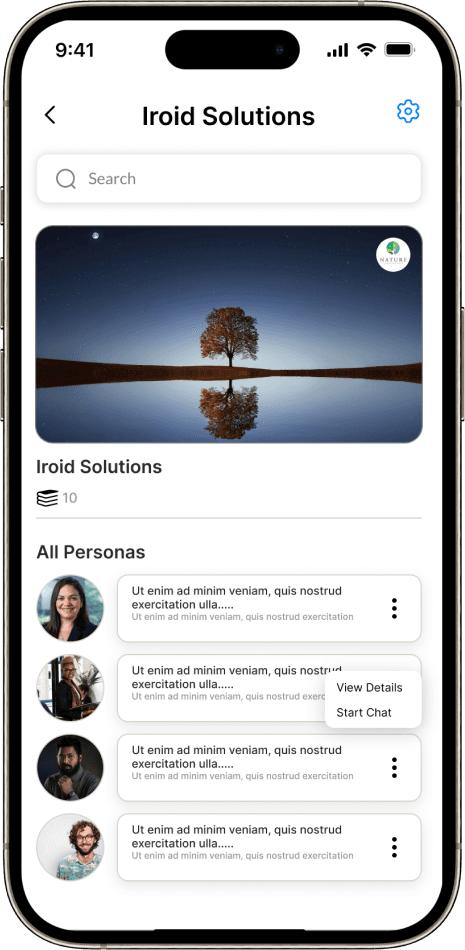
Employees practice sales, service, and leadership dialogs with AI personas that respond contextually, mimicking real prospects, customers, or team members.
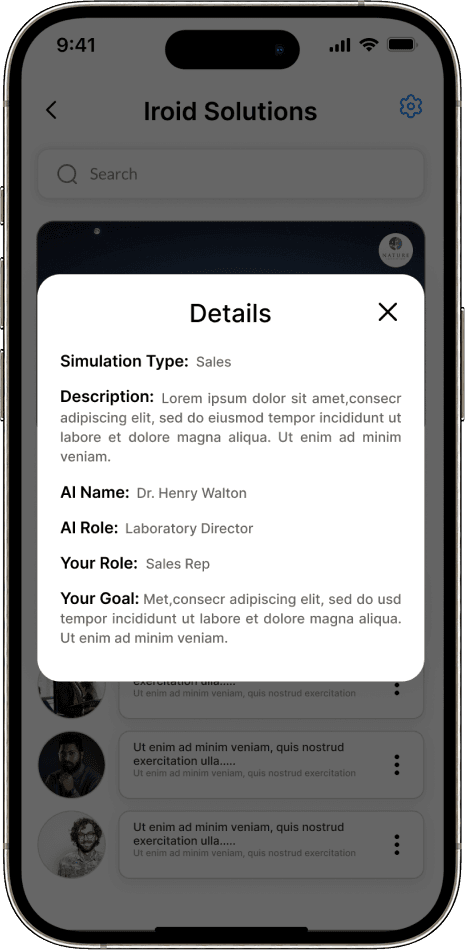
Trainers create scenario outlines and define AI personas (e.g., skeptical customer, anxious patient, resistant employee), then assign these simulations to learners based on role and skill level.
Sales reps, service agents, and leaders see different scenario bundles tailored to their daily conversations, ensuring practice is relevant and focused.
After each simulation, learners receive feedback on their responses—covering areas like clarity, empathy, objection handling, and closing—along with suggestions to improve future conversations.
Points, scores, and completion badges make practice engaging, while dashboards show individual and team progress over time.
Employees can practice on Android, iOS, or web, making it easy to fit training into busy schedules, whether at the office or on the go.
Training managers use a web‑based admin panel to create, edit, and publish scenarios, manage user accounts, allocate tokens for AI usage, and monitor training activity.
Node.js/Express APIs, MySQL, and AWS hosting provide a robust backend that can support multiple organizations, high chat volume, and ongoing content updates.

Challenges
Solutions
If AI replies feel generic or scripted, learners don’t take the training seriously and the impact drops.
We integrated configurable personas and scenario logic so the AI can react differently based on user input, giving each simulation a natural back‑and‑forth flow that mirrors real conversations.
Training teams needed the ability to build and modify scenarios themselves, without relying on developers for every change.
The admin panel includes intuitive forms and editors for scenario outlines, persona traits, and assignment settings, making it easy for non‑technical staff to manage learning content.
Simply finishing a scenario doesn’t prove whether someone actually improved their communication skills.
We implemented scoring models and feedback metrics tied to conversation quality (handling objections, empathy, structure, confidence), giving trainers actionable insight into who is progressing and where they need support.
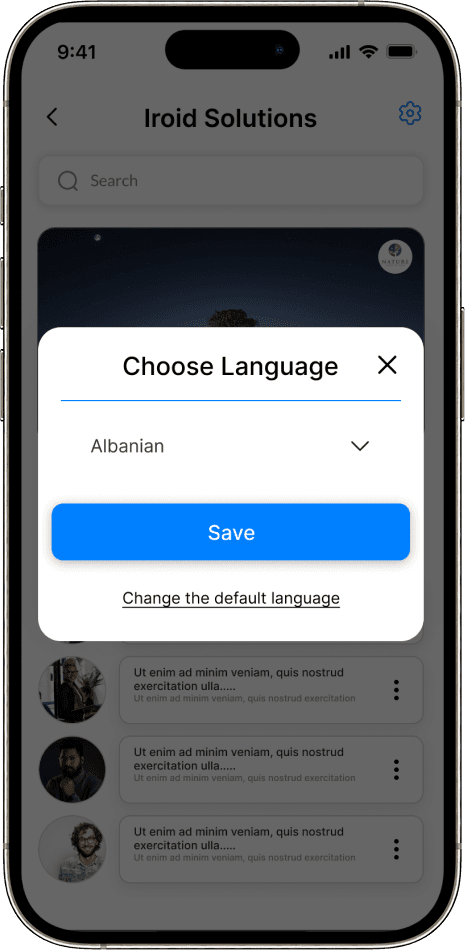
The app needed to work for sales, customer service, healthcare, leadership coaching, and more, each with their own language and context.
The scenario system was designed to be domain‑agnostic, allowing clients to plug in industry‑specific content and personas while reusing the same AI simulation and coaching engine.
AI chat usage is token‑based, and the platform needed to avoid runaway costs as usage grows.
Admins can set token limits, monitor consumption, and design scenarios with efficient dialogue flows, balancing rich training experiences with predictable resource usage.
Have an app, web platform, AI solution, or custom software idea? Share it with us and get practical guidance from an experienced product development team.
Need a mobile app, web app, AI solution, or custom software?
Get a free consultation and discuss your project with our team.
Business



Passionate about mobile apps, websites, AI, and software development?
Join our growing team!
HR