Loading…
Contact Us
Get a free consultation!
Contact Us
Get a free consultation!
AIServe makes ordering from local restaurants simple, secure, and ready for AI‑powered voice ordering in the future.


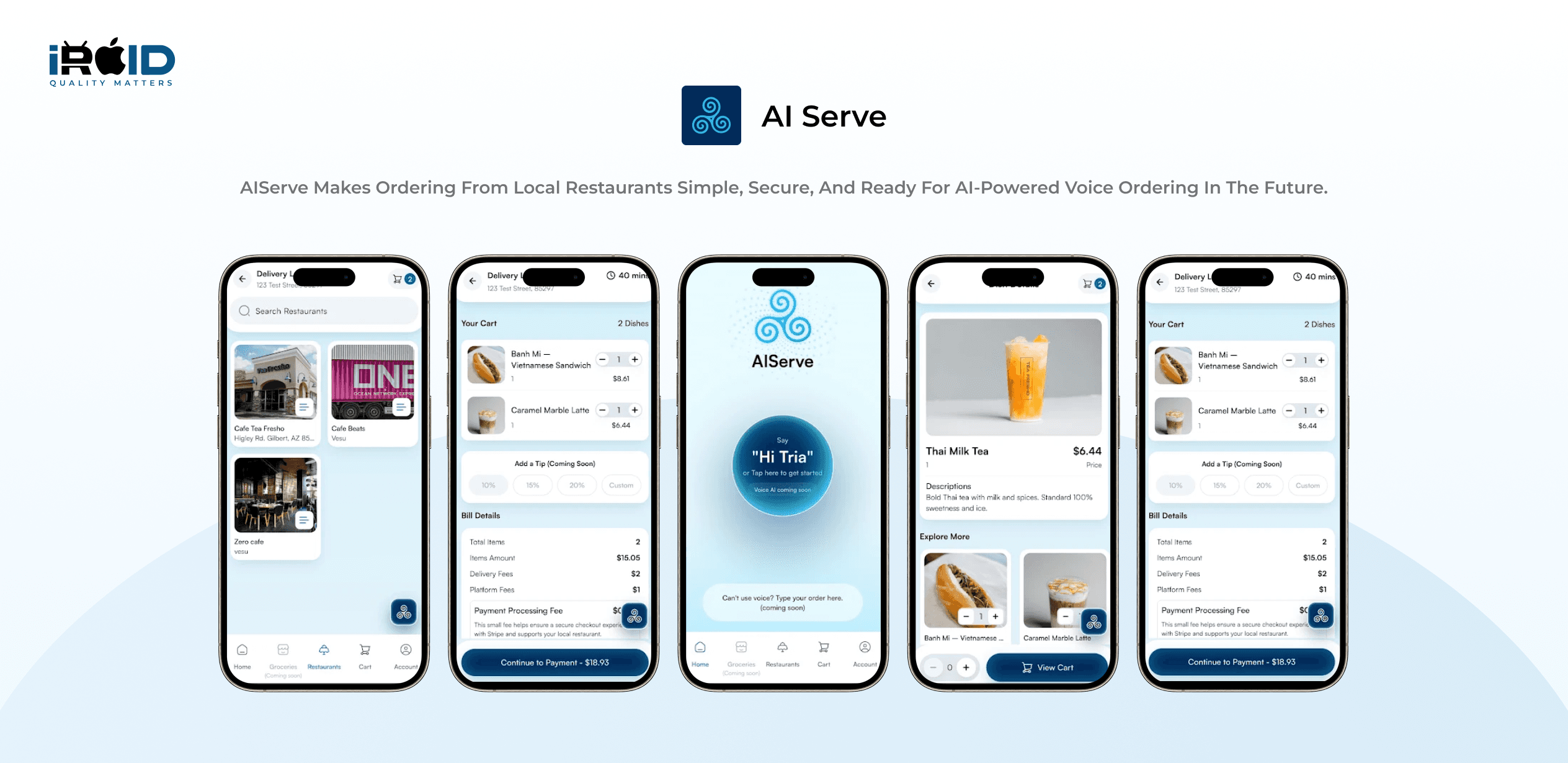
AIServe is a cross‑platform food ordering app that connects local restaurants with nearby customers through a clean, mobile‑first experience.
The client partnered with your team to build a Flutter app (Android and iOS) backed by a Node.js API, focusing on fast ordering, Stripe‑based payments, and a reliable foundation for upcoming AI voice ordering and multi‑restaurant expansion.
Tools

Xcode

Android studio

VS code

Git
UI/UX

Figma
Cloud/Server

AWS

GoDaddy

Apache
Database

MongoDB
Back-end

NodeJs
Front-end

React

EJS

HTML5

CSS3

JavaScript

jquery
Mobile

Flutter

Dart

Flutter
1 Member

Node.js
1 Member

QA
1 Member

React
1 Member

UI/UX
1 Member

Project Manager
1 Member
AIServe was created as an early‑stage AI project with a very practical first step: make it effortless for people to order from a local restaurant without dealing with clunky websites or phone calls. The product starts with one partner restaurant and one delivery zone, proving the experience before scaling to more partners and features.
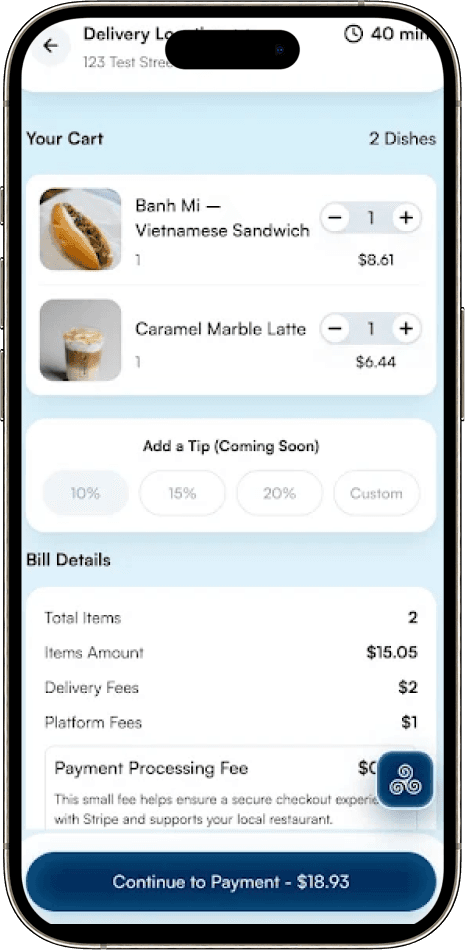
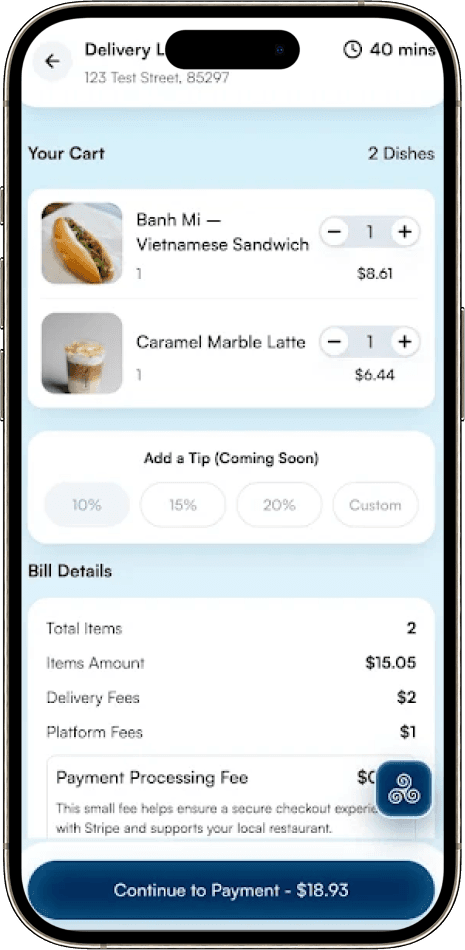
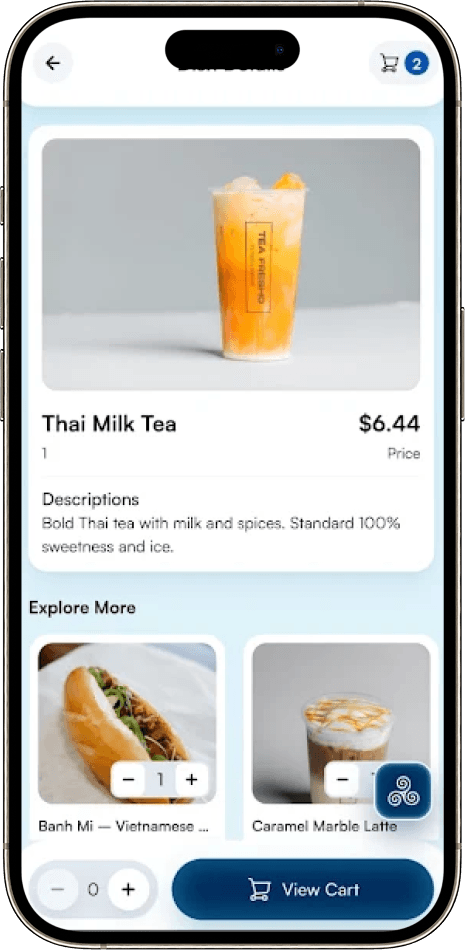
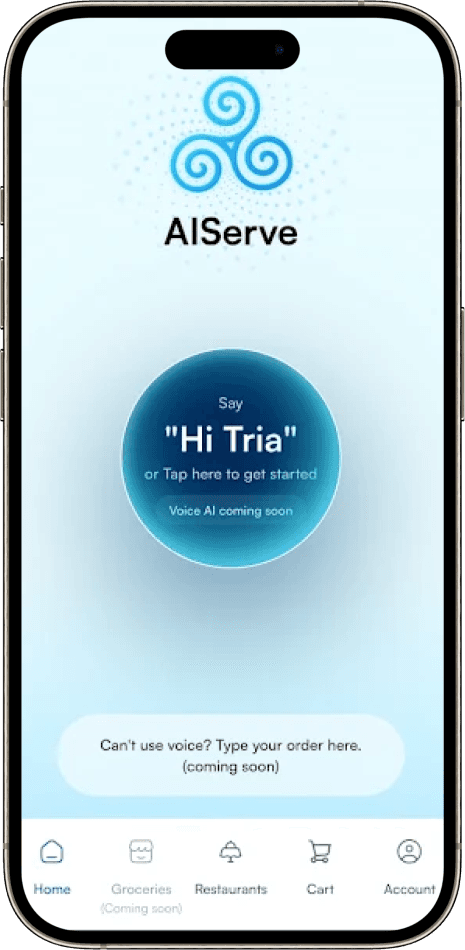
In the app, users tap “Get Started” to view the curated menu, pick their items, and move through a streamlined checkout flow powered by secure Stripe integration. Once an order is placed, users can review their order history from inside the app, giving them a simple record of what they’ve ordered and when. Even users outside the current delivery zone can still explore the app and see how AIServe works, building familiarity for future expansion.
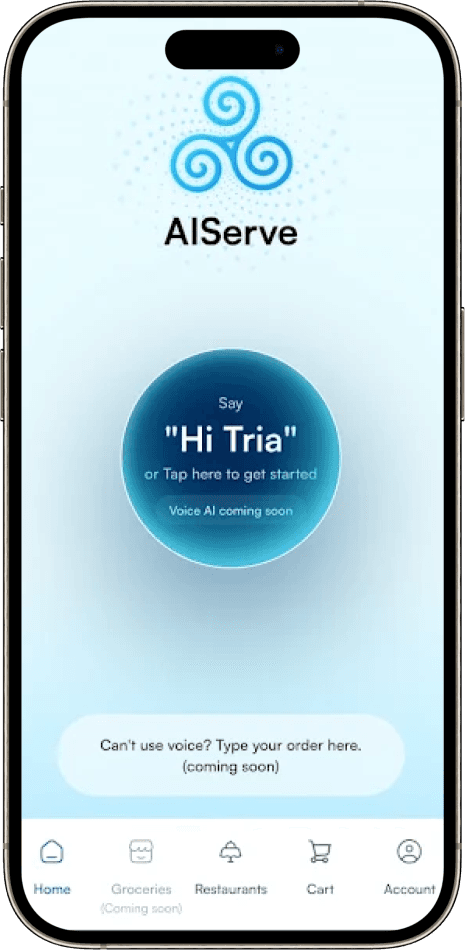
Under the hood, the system is built in Flutter for a consistent Android and iOS experience, with a Node.js backend managing products, orders, users, and payment flows. The architecture is intentionally lightweight but structured to support the next phase: voice ordering with “Tria” (the AI assistant), scheduled orders, tipping, and multiple restaurants across larger service areas.
The main business goal of AIServe is to create a modern ordering experience for local restaurants that feels as polished as big delivery platforms—but with more control over the customer relationship and the ability to layer in AI over time.
For the first partner restaurant, AIServe aims to increase direct orders, reduce friction for repeat customers, and collect insight into ordering behaviour. At a strategic level, the platform is designed to grow into a multi‑restaurant marketplace with AI‑driven voice ordering, smart recommendations, and more flexible delivery options, starting from a strong, reliable core.
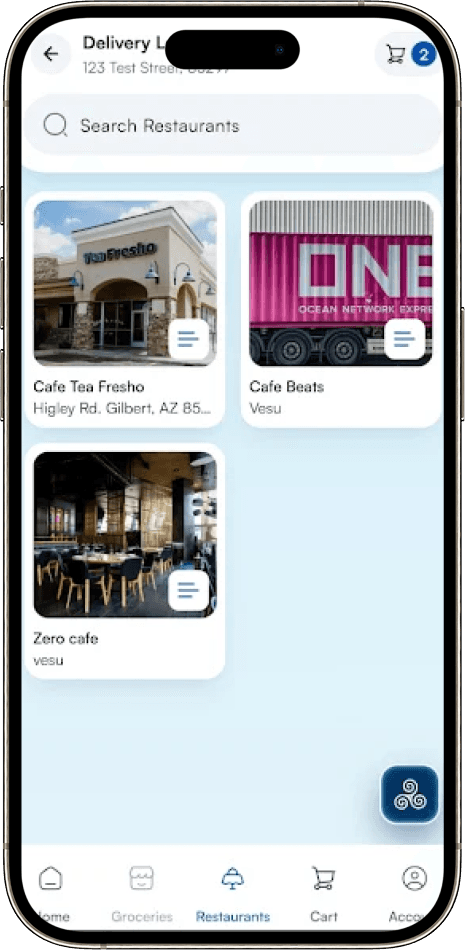
Users open the app, browse a curated menu, add items to their cart, and place orders in just a few screens, without distractions or unnecessary complexity.
Integrated Stripe payments provide a trusted, familiar checkout experience, handling card payments securely while keeping the UI clean and minimal.
Customers can view their past orders inside the app, making it easy to reorder favourites or review what they tried previously.
AIServe currently partners with a specific local restaurant and delivery area, ensuring a tightly controlled, high‑quality experience before expanding to more locations.
A single Flutter codebase powers both Android and iOS apps, ensuring consistent UX, faster development, and easier maintenance.
A Node.js backend manages menu data, orders, user authentication, and payment coordination, providing a scalable base for future AI and multi‑restaurant features.
The architecture already anticipates upcoming capabilities like voice ordering with an AI assistant, scheduled orders, tips, and multiple restaurant listings, so growth is a natural next step rather than a rebuild.

Challenges
Solutions
The client wanted a simple v1 that works today, but also a clear path to AI voice ordering and more restaurants tomorrow.
The app experience is intentionally focused and minimal, while the backend and data models are designed with multi‑restaurant support and AI hooks in mind, so new features can be layered in without breaking the core.
New ordering apps must quickly prove they are safe and reliable, especially when handling payments.
The interface leans on clarity and familiarity—Stripe for checkout, transparent flows, and simple screens—so users feel confident using the app even in its early launch phase.
Many customers will be trying AIServe for the first time, often just to order from a single restaurant.
The app removes optional distractions: one clear entry point, direct menu browsing, and a straightforward cart and checkout, so users can complete their first order without any learning curve.
People outside the supported area may still download the app out of curiosity.
AIServe allows anyone to explore the experience but clearly communicates when live ordering is limited to the current partner and zone, managing expectations while still showcasing the product.
Voice ordering involves new UX patterns and more complex backend logic.
The current system isolates ordering and menu logic behind APIs, making it easier to later plug in an AI assistant that can drive the same flows via voice while reusing the existing order pipeline.
Have an app, web platform, AI solution, or custom software idea? Share it with us and get practical guidance from an experienced product development team.
Need a mobile app, web app, AI solution, or custom software?
Get a free consultation and discuss your project with our team.
Business



Passionate about mobile apps, websites, AI, and software development?
Join our growing team!
HR