Loading…
Contact Us
Get a free consultation!
Contact Us
Get a free consultation!
RupeeNex helps individuals and businesses understand, track, and manage their finances through a modern, web‑based dashboard and insight‑driven tools.

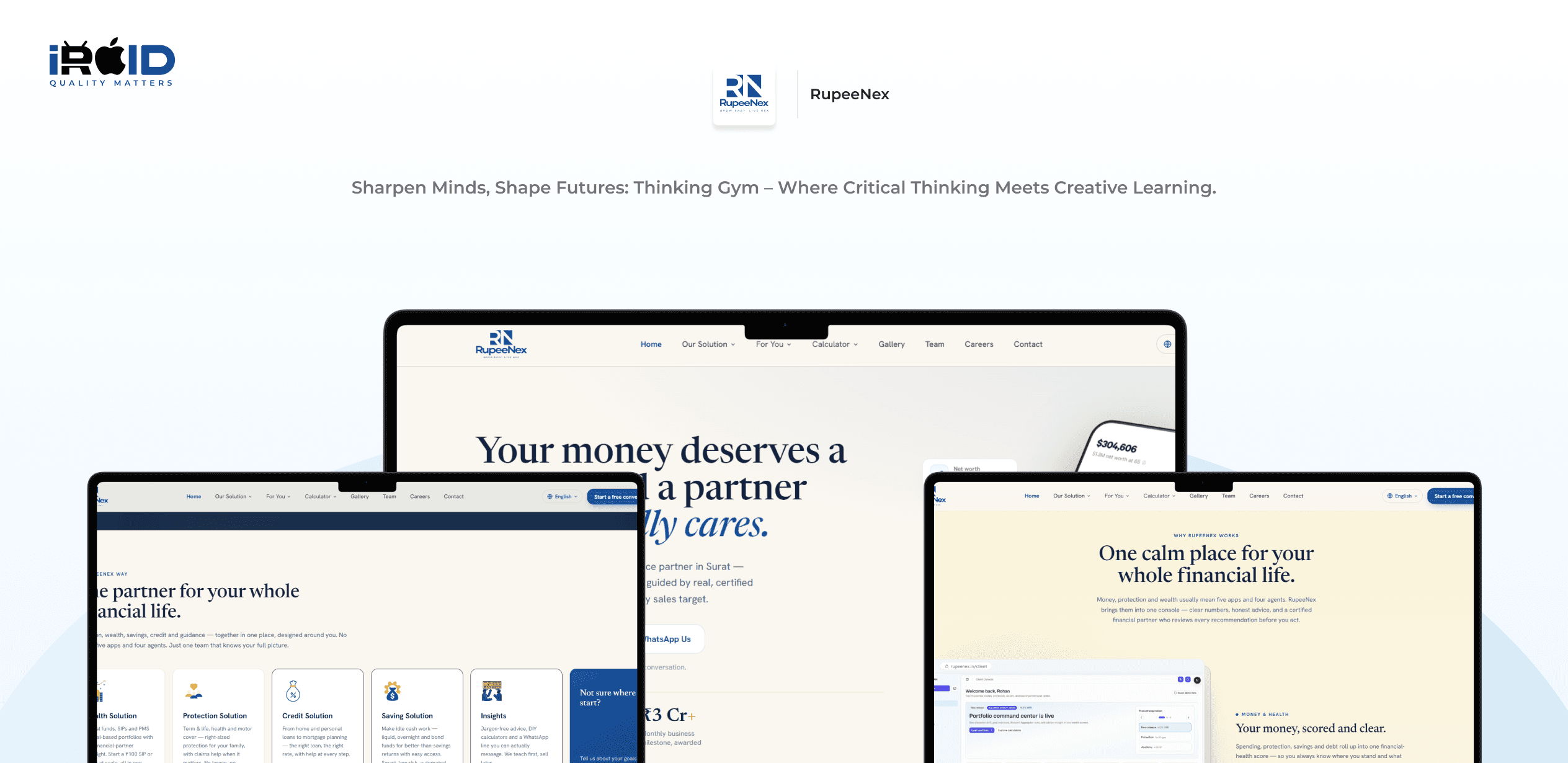
Rupeenex is a web‑based fintech platform built to make financial information easier to see, understand, and act on.
iRoid Solutions developed the public website, core web app, and admin portal using React.js on the front end and Node.js/Express with PostgreSQL on the backend, creating a secure and scalable foundation for Rupeenex to offer financial services and portfolio insights online.
Tools

VS code

Git
Cloud/Server

AWS
Database

MongoDB
Back-end

NodeJs
Front-end

React

HTML5

CSS3

JavaScript

jquery


Node.js
1 Member

QA
1 Member

React
1 Member

Project Manager
1 Member
Financial products are often complex, with scattered statements, confusing dashboards, and a lot of jargon that makes decision‑making harder than it should be. Rupeenex set out to change that by offering a clean, web‑based interface where users can view their key financial information, track performance, and access relevant services in a few simple clicks.
The public website, built in React.js, introduces the brand, explains the value proposition, and guides visitors into the main platform. Once logged in, users interact with the Rupeenex web app, an SPA (single‑page application) that surfaces account information, analytics, and tools through responsive, card‑based dashboards. A separate React‑powered admin portal lets internal teams manage users, products, configurations, and content without touching code.
Behind the scenes, a Node.js + Express backend handles authentication, business logic, and integrations with financial data sources, while PostgreSQL stores user profiles, transaction data, configurations, and reporting information. This stack gives Rupeenex a flexible, API‑driven architecture that can grow as new products or markets are added.
The key business goal for Rupeenex is to provide a modern, trustworthy digital layer over financial services, so users can see their money clearly and act with confidence.
Instead of forcing people to log into multiple portals or decode raw statements, Rupeenex presents insights in a structured, visual way, helping them understand balances, flows, and performance at a glance.
For the company, the platform is designed to support current offerings and future expansion: adding new financial products, onboarding partners, and rolling out additional tools without having to rebuild the core. The separation between the public site, client web app, and admin portal also supports better marketing, customer onboarding, and internal control.
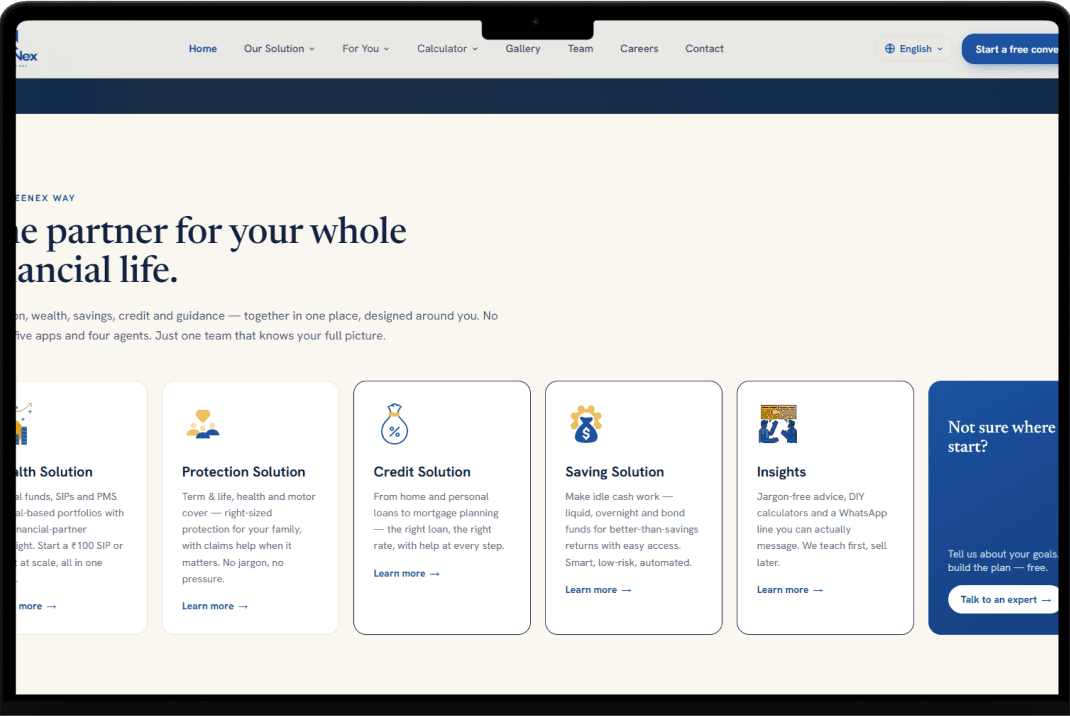
A React‑based marketing site explains Rupeenex’s services, benefits, and trust factors, and guides potential users smoothly into sign‑up or login flows.
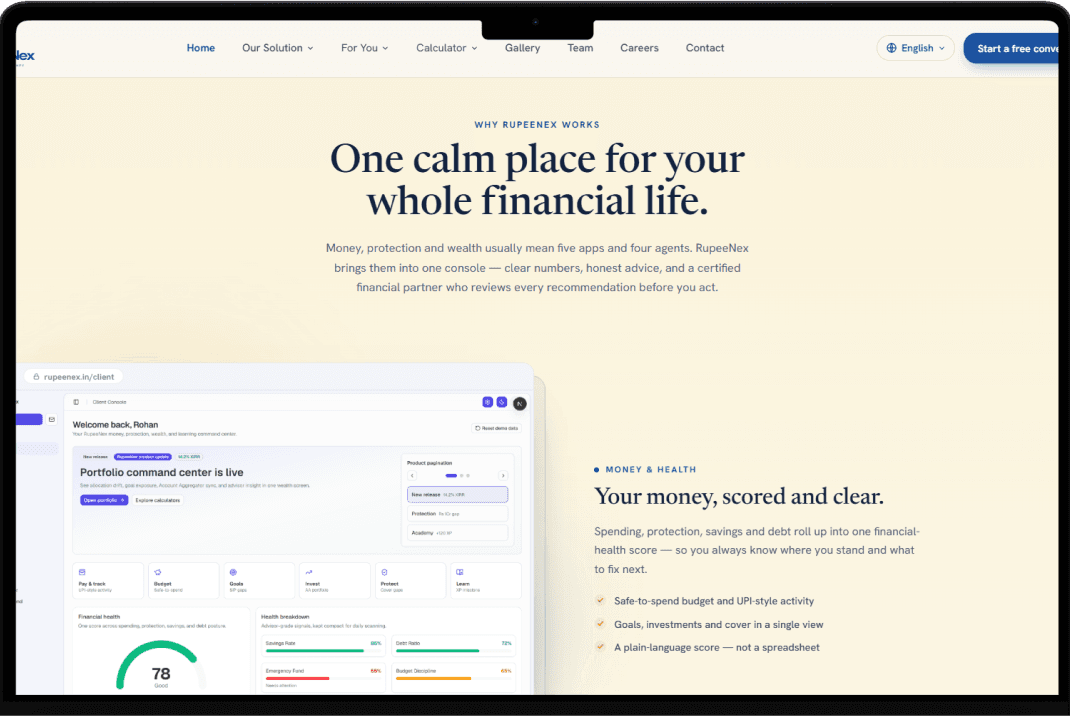
Logged‑in users access an SPA dashboard where key financial data is presented through charts, tables, and summaries, making complex information easier to digest.
Admin users get a dedicated React portal to manage clients, products, content, and settings, reducing dependency on developers for routine updates.
A Node.js/Express backend powers authentication, business logic, and integrations with external services, exposing clean APIs for the front ends.
PostgreSQL is used for reliable, structured storage of users, transactions, configurations, and logs, supporting strong consistency and reporting.
All front‑end experiences are responsive, so users and admins can access Rupeenex from laptops, tablets, or desktop screens comfortably.

Challenges
Solutions
Large volumes of data can easily become confusing or intimidating for non‑experts.
The UI focuses on clear hierarchy, high‑level summaries first, detailed drill‑downs second, with visual charts and concise labels that highlight what really matters.
The platform needed to support current use cases while staying open to new financial offerings.
The backend and database were designed with modular entities (users, products, accounts, transactions, settings), so new product types can be added with minimal structural changes.
Financial platforms must provide a strong sense of safety and technical robustness.
Secure coding practices, layered architecture, and clear UX patterns around login, sessions, and sensitive actions help build user trust alongside the underlying Node.js/PostgreSQL stack.
Business and support teams needed to manage content and users without touching production code or databases directly.
A dedicated React admin portal with role‑based access allows staff to manage data safely through controlled interfaces, reducing errors and operational risk.
Over time, more users and transactions can put pressure on queries and API response times.
The system is structured with efficient PostgreSQL queries, pagination, and API optimisation, so dashboards remain fast even as datasets increase.
Have an app, web platform, AI solution, or custom software idea? Share it with us and get practical guidance from an experienced product development team.
Need a mobile app, web app, AI solution, or custom software?
Get a free consultation and discuss your project with our team.
Business



Passionate about mobile apps, websites, AI, and software development?
Join our growing team!
HR