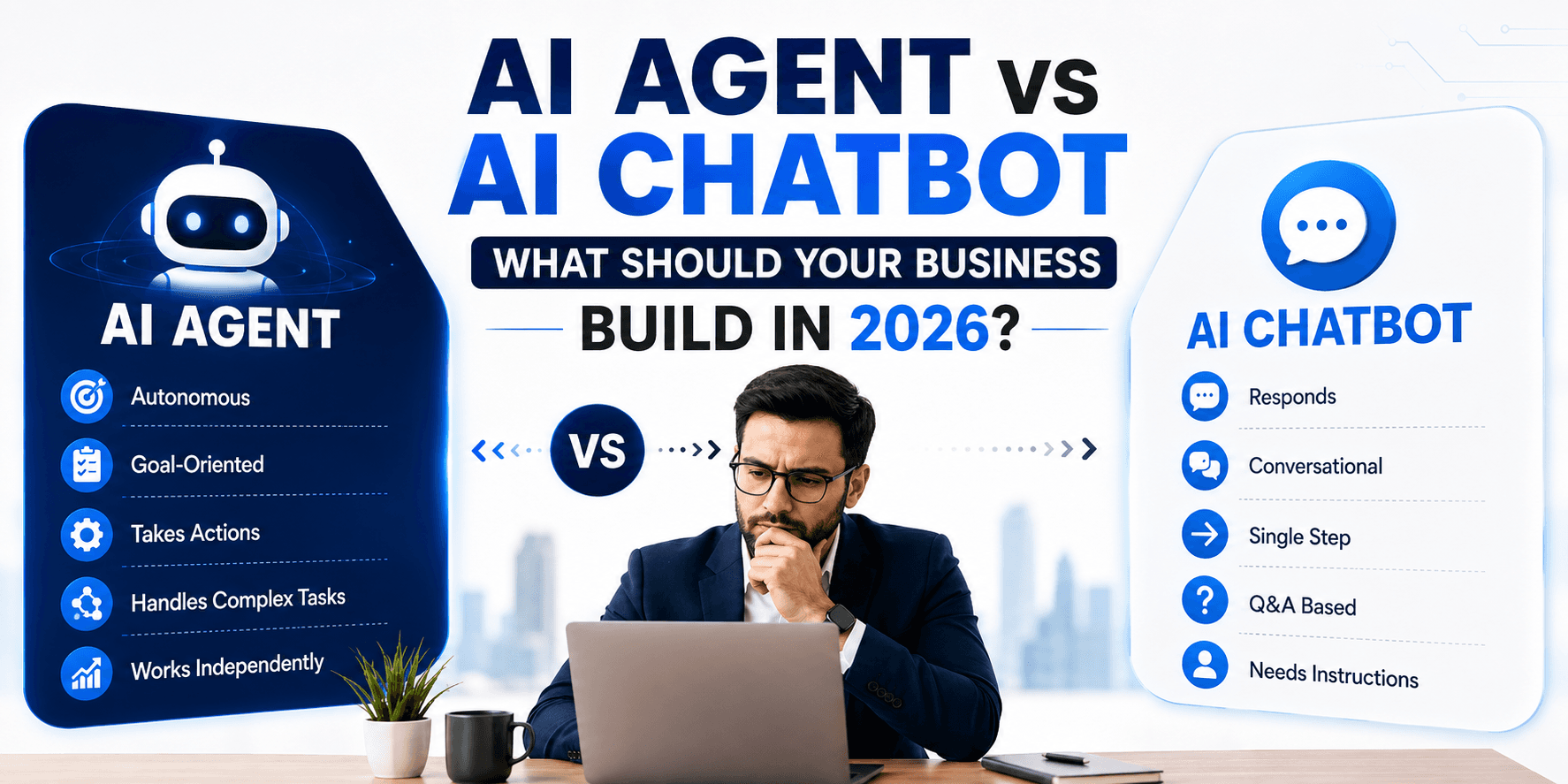

AI-powered mobile app development is no longer optional for growth-focused companies; it is becoming a core strategy for improving customer experience, automating workflows, and creating smarter digital products in 2026. Businesses are investing faster because AI adoption in organisations jumped to 78% in 2024, and generative AI use in at least one business function rose from 33% to 71% in the same period.
Introduction
Artificial Intelligence has moved from experimentation to execution, especially in mobile products where user expectations now revolve around personalisation, instant support, and predictive experiences. For businesses, AI-powered mobile apps can improve engagement, reduce manual work, and unlock new revenue streams by turning app interactions into data-driven decisions.
From AI chatbots and recommendation engines to fraud detection and voice interfaces, mobile apps are becoming more adaptive and intelligent. This guide explains what AI-powered mobile app development means, why it matters for businesses, which technologies power it, what it costs, and how to implement it effectively in 2026.
What Is AI-Powered Mobile App Development?
AI-powered mobile app development means integrating technologies such as machine learning, natural language processing, computer vision, and generative AI into mobile applications so they can analyse data, automate actions, personalise user journeys, and improve over time. Unlike traditional apps that operate through fixed rules, AI-enabled apps learn from user behaviour and historical data to deliver smarter outputs and recommendations.
A simple way to understand the difference:
-
Traditional app: shows the same flow or content to every user.
-
AI-powered app: learns preferences, predicts intent, and adjusts content or responses dynamically.
For example, a streaming app can recommend content based on watch history, while a shopping app can personalise product rankings and offers in real time.
Why Businesses Are Investing
The AI market is expanding rapidly, although estimates vary by research firm. Grand View Research projects the global AI market will reach $539.45 billion in 2026, while another market forecast places it at $601.93 billion in 2026. At the same time, Gartner-reported coverage shows generative AI model spending is expected to grow 80.8% in 2026, reflecting how strongly enterprises are funding AI capabilities.
Customer experience is one of the strongest drivers behind this investment. McKinsey-referenced reporting says 41% of surveyed companies already use AI to differentiate customer experience, and more than half are deploying AI for customer service automation and faster response times. In mobile specifically, 44% of apps use AI-based personalisation, and 78% of consumers prefer apps with AI-driven personalisation.
Key reasons businesses are prioritising AI mobile apps include:
-
Better customer experience through recommendations, smart search, voice assistance, and real-time support.
-
Higher operational efficiency by automating support, data handling, lead qualification, and repetitive workflows.
-
Stronger retention and conversion through behaviour-based personalisation and predictive engagement.
-
Faster innovation using generative AI for assistants, content generation, and multimodal app experiences.
Core Technologies
Machine Learning
Machine learning helps mobile apps learn from user actions, usage history, and business data to improve predictions and outcomes automatically. Common business use cases include recommendation engines, churn prediction, customer segmentation, and demand forecasting.
Deep Learning
Deep learning uses neural networks to recognise complex patterns in large datasets, especially for speech, images, and advanced predictions. It is widely used in facial recognition, image classification, voice interfaces, and medical diagnostics.
Natural Language Processing
NLP allows apps to understand and generate human language, making it essential for AI chatbot app development, translation, voice search, and sentiment analysis. This is one of the most important layers in AI mobile app development because it powers conversational interfaces and supports automation.
Computer Vision
Computer vision enables mobile apps to process images and visual inputs from cameras or uploaded media. It supports features such as object detection, QR scanning, product identification, biometric verification, and AR-enabled retail or healthcare experiences.
Generative AI
Generative AI mobile app development focuses on systems that can produce text, summaries, images, code, and contextual responses. It is increasingly used for AI assistants, chat interfaces, personalised responses, knowledge search, and content creation workflows inside business apps.
Benefits of AI in Mobile Apps
Businesses adopt AI in mobile apps because the gains are both customer-facing and operational. The most important benefits include:
-
Personalised user experience: AI can tailor feeds, product recommendations, notifications, and workflows to individual users.
-
Improved support: AI chatbots enable 24/7 service, faster responses, and lower support overhead.
-
Predictive analytics: companies can forecast churn, purchases, and revenue trends using app data.
-
Automation: AI reduces repetitive work in scheduling, data processing, content generation, and qualification tasks.
-
Better security: AI strengthens fraud detection, anomaly monitoring, and biometric authentication.
These improvements translate into measurable business outcomes. AI-enabled mobile apps have been associated with higher customer satisfaction, stronger engagement, and improved conversion performance, while AI-driven features can increase mobile app engagement by up to 35%, according to industry reporting.
Use Cases Across Industries
AI-powered apps for business now span nearly every industry, but some sectors show especially strong impact.
|
Industry |
Common AI mobile app use cases |
|
Healthcare |
Symptom checkers, patient monitoring, telemedicine support, and medical image analysis. |
|
E-commerce |
Product recommendations, dynamic pricing, smart search, and shopping assistants. |
|
FinTech |
Fraud detection, credit scoring, AI banking assistants, transaction monitoring. |
|
Education |
Personalised learning, AI tutors, automated assessments, and learning analytics. |
|
Real Estate |
Property matching, virtual tours, lead qualification, and price prediction. |
|
Logistics |
Route optimisation, delivery prediction, warehouse workflows, fleet intelligence. |
For example, e-commerce apps use AI to rank products and tailor offers, while financial apps use AI for fraud detection and personalised advisory experiences.
Essential Features
The most effective artificial intelligence mobile apps usually include a mix of intelligence, automation, and usability features. Core features often include:
-
User personalisation engine for behaviour analysis and recommendations.
-
AI chatbot for customer support, lead capture, and FAQ handling.
-
Voice recognition for commands, search, and navigation.
-
Smart search with natural language understanding and predictive suggestions.
-
Predictive analytics dashboards for business insights and user behaviour trends.
-
Image recognition for scanning, object detection, and identity or product verification.
Development Process
A practical AI-powered mobile app development process usually follows eight stages:
-
Define the business objective and identify the exact problem AI should solve.
-
Map AI opportunities around customer pain points, inefficiencies, or revenue gaps.
-
Collect and prepare quality data from app activity, CRM systems, support logs, and external datasets.
-
Choose between pre-trained AI models and custom models based on budget, speed, and accuracy needs.
-
Design the app around usability, trust, and transparent AI interactions.
-
Integrate the AI layer, such as NLP services, ML engines, computer vision modules, or generative AI APIs.
-
Test model accuracy, performance, scalability, privacy, and security.
-
Deploy with ongoing monitoring, retraining, and optimisation.
This process matters because many companies still struggle to scale AI effectively; McKinsey-linked reporting notes that fewer than one in four companies have scaled AI successfully across all customer-facing functions.
Best AI Tools and Technologies
Businesses building AI mobile apps commonly use mature frameworks and platform services rather than starting from scratch. Production AI ecosystems highlighted across market and business coverage include TensorFlow, PyTorch, Core ML, ML Kit, and enterprise generative AI platforms such as OpenAI, Anthropic, and Google Gemini.
A useful way to group them is:
-
Model development: TensorFlow, PyTorch.
-
On-device mobile AI: Core ML, ML Kit.
-
Conversational and generative AI: OpenAI, Anthropic, Google Gemini.
For many businesses, pre-trained APIs are the fastest path to market because they reduce infrastructure burden and accelerate testing.
AI App Development Cost
AI app development cost depends on the complexity of the AI features, the amount and quality of data required, the need for model training, and the size of the delivery team. Projects also become more expensive when they require custom models, cloud infrastructure, ongoing retraining, and enterprise-grade governance.
A practical business-side estimate looks like this:
-
Basic AI app with limited features, such as a chatbot or light recommendations: $15,000 to $40,000.
-
Mid-complexity AI mobile app with predictive analytics or multi-feature intelligence: $40,000 to $100,000.
-
Enterprise AI solution with custom models, security controls, and advanced integrations: $100,000 to $500,000+.
For startups, pre-trained APIs and focused MVP scope are usually the most cost-effective route because they reduce development time and infrastructure spend.
Challenges and Security
AI integration in mobile applications creates real business value, but it also introduces challenges around compliance, accuracy, infrastructure, and maintenance. McKinsey-linked reporting notes that 51% of respondents experienced at least one negative consequence from AI use, with inaccuracy being the most common issue.
Common challenges include:
-
Data privacy and regulatory compliance, including GDPR, CCPA, and local market rules.
-
AI bias caused by poor or unbalanced training data.
-
High infrastructure costs tied to cloud compute, storage, and model hosting.
-
Continuous model maintenance, monitoring, and retraining requirements.
Security best practices for AI-powered mobile apps include encrypting user data, securing APIs, using MFA or biometrics, monitoring for adversarial attacks, and protecting model pipelines against tampering or poisoning.
Future Trends
Several trends are shaping the next wave of AI-powered mobile app development in 2026 and beyond.
-
On-device AI is growing because businesses want faster experiences, better privacy, and less cloud dependency.
-
Multimodal AI is becoming more important as apps combine text, image, voice, and video understanding in one workflow.
-
AI agents are emerging as apps move from answering questions to completing tasks autonomously.
-
Hyper-personalisation is deepening as mobile apps use behaviour, context, and predictive signals together.
-
AI with AR and immersive experiences is expanding in retail, education, healthcare, and commerce.
Sensor Tower-referenced reporting also showed time spent in generative AI apps reached 48 billion hours in 2025, about 3.6 times the level seen in 2024, which signals how quickly AI-native usage patterns are scaling on mobile.
How to Choose an AI App Development Company
Choosing the right AI app development company is as important as choosing the technology stack. Businesses should evaluate partners based on technical depth, mobile delivery expertise, AI integration capability, and long-term scalability planning.
Focus on these evaluation areas:
-
Technical expertise in AI/ML, NLP, generative AI, and mobile app engineering.
-
Portfolio relevance, especially projects in similar industries or use cases.
-
Scalability readiness for high traffic, model updates, and future AI enhancements.
-
Security and governance practices for privacy, compliance, and model reliability.
Conclusion
AI-powered mobile app development is reshaping how businesses engage customers, automate operations, and drive growth. Companies that adopt AI strategically gain a significant competitive advantage through personalisation, predictive insights, intelligent automation, and superior customer experiences.
The key to success is identifying the right business problem, selecting the appropriate AI technologies, ensuring data quality, and partnering with experienced development experts. If your business is exploring AI-powered mobile app development, iRoid Solutions can help you plan, design, and build scalable mobile applications tailored to your business goals.
If you're planning to build an AI-powered mobile application, now is the time to invest. Businesses that move early will be better positioned to dominate their markets as AI becomes a standard feature in modern mobile experiences. Contact Us at iRoid Solutions to discuss your project, explore AI opportunities, and build a future-ready mobile app that delivers measurable business results.